OT-IT Integration:
Control plant processes with real-time data
Convert OT live data into controlled operational processes, documented transparently, without any data discontinuity.
OT-IT Integration is already delivering live data at many plants. In day-to-day operations, however, coordination often still determines who performs checks, who approves, what happens when a threshold value is exceeded, and where this can be documented.
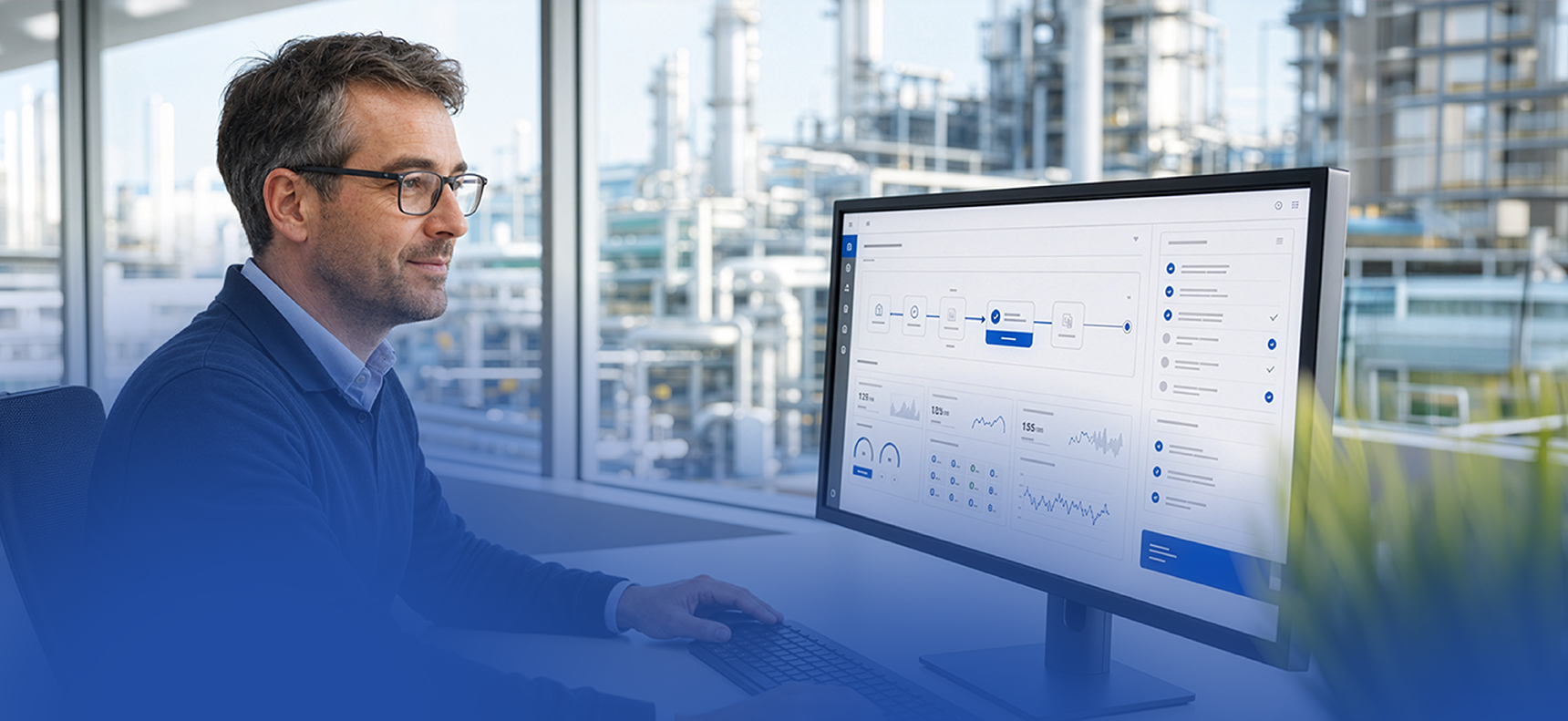
The Task Manager links OT live data to modeled operational processes and controls the workflow: manual or trigger-based start, automatic steps based on properties and actions, branching based on approvals, tablet-guided inspection tasks—all within a single audit trail.
This results in a production digital twin (Living Digital Twin) on two levels: plant/line and product, updated over time at relevant process points. Robotics can also be integrated, provided it is modeled as a platform action. The Task Manager manages the operational workflow; robot and PLC programming remain at the device level.
doubleSlash designed and developed a solution for an international company in the chemical industry and integrated it into the existing plant-level IoT/OT platform.
Interested in what's possible for your business? Let's talk about it.
Why OT-IT integration alone rarely supports plant processes
Once connectivity is established, the question of shift work arises:
- What happens to the data during shift operations?
- Who performs the verification and approval steps, and how are responses recorded?
- Who controls the next step, and who monitors its execution?
- Where is the auditable documentation located?
The company uses an integrated OT platform (asset information, properties, actions). doubleSlash has enhanced the Task Manager: It links this database to BPMN business processes and executes approvals, follow-up steps, and asset actions directly from within the process.
Result: Operations and Quality teams view status, real-time metrics, next steps, and responsible parties. The Task Manager tracks instances, triggers threshold-based responses, and continues the workflow based on documented decisions.
Digital Twins in Production: The plant/line and product are updated synchronously over time and remain connected within the same data environment.
Framework and Requirements
The company is known for its heterogeneous plant landscapes, cross-site control, and high standards for safety, quality, and traceability.
The Task Manager transforms the OT database into controllable operational processes: measured values, thresholds, and plant actions are interlinked with human approvals. The PLC remains responsible for plant automation. The Task Manager directs operational workflows (start, branch, action, stop) and ensures governance.
When OT-IT integration provides data, operational processes often do not scale accordingly
A common scenario for CIOs, IoT, plant, and quality managers: OT-IT integration provides data. Operational coordination, however, continues as before.
- Approvals and checklists are still handled via email, Excel, or siloed systems.
- Threshold values do not trigger standardized follow-up processes.
- Shift coordination and the effort required for coordination increase as the number of systems grows.
- Audit and QA can only reconstruct decisions with great effort ("Who confirmed what, and when?").
- Operational knowledge resides in people’s minds; generic workflow tools do not recognize properties or equipment actions.
- The production digital twin remains merely a model or dashboard without a continuous time series of approvals and logs.
Consequence: Data silos despite the IoT, fragmented digital twins, and processes that can't keep up with the complexity of the plant.
Operational processes directly based on the OT database
doubleSlash has integrated the Task Manager—as a process component of the OT-IT integration—with the OT database (bill-X ActiveDB):
Process owners
- Define, version, and prioritize BPMN workflows
- Configure triggers
Shift / Production Management
- Monitor instances
- Manage responsibilities
- Maintain reference material
Production Staff
- Processing tasks on a tablet
- Complete steps with documented
- Answers
Requirements:
- Active control (start, branching, system actions)
- Automated and manual steps within the same process
- Maintenance by business roles without the full IT release chain
- Role-based access and logging.
Approach:
Prioritization of workflows, process design and PoC, integration, rollout with enablement, and phased expansion during operation.
What's Changing at Work
The solution addresses operational risks caused by insecure execution:
Procedure Compliance
Knowledge Preservation
Coordination
Control
Transparency
Digital Twin in Manufacturing
Audit and QA
For decision-makers (Operations, Plant Management, IoT/OT, Quality), this means, specifically:
- Active Management
- Consistent execution of critical processes
- Faster onboarding
- Less shift coordination
- Faster audit preparation
- More predictable service processes based on live data
- in addition to remote access
Typical Application Patterns
- Review and Approval Processes
Review prior to an asset action, with response options and an attachment; the result determines the next step, such as approval for the action or rejection for escalation. Event-Driven Responses
A threshold value or schedule triggers the instance and assigns it to the defined workflow.Data-Driven Actions in the Flow
Automatic steps read or set properties or trigger actions, such as a robot step after approval. Line and product twins are updated in the same instance with precise timestamps.
- Robotics in Operational Processes
Robot actions via the platform action model in the BPMN workflow, linked to manual approvals, within a process instance and audit trail. Production Digital Twin: Plant and Product in the Time Series
Executed process steps supplement the time series for the production line and product in the Living Digital Twin.Transparency for Operations and Governance
Shift supervisors view active instances, production processes the queue, and completed runs remain accessible for auditing.
Features at a Glance
Process Catalog
Modeling According to BPMN 2.0
Tablet Version
Reference Materials and Knowledge Loop
Triggers Based on Live Data
Orchestration and Control
Monitoring
Security
Comprehensive Implementation
- Concept Development and Process Design
Prioritized workflows from the workshop to the PoC. - OT/IT Integration into IoT/OT Platforms
Integration with properties, actions, and triggers; transferable to comparable architectures (Azure IoT, AWS IoT, ThingWorx, etc.).
- Rollout and Enablement
Roles, Governance, and Enablement of Business Roles. - Expansion and Operations
Roll out additional processes and continue to develop them during operations.




 +49 7541 70078-781
