
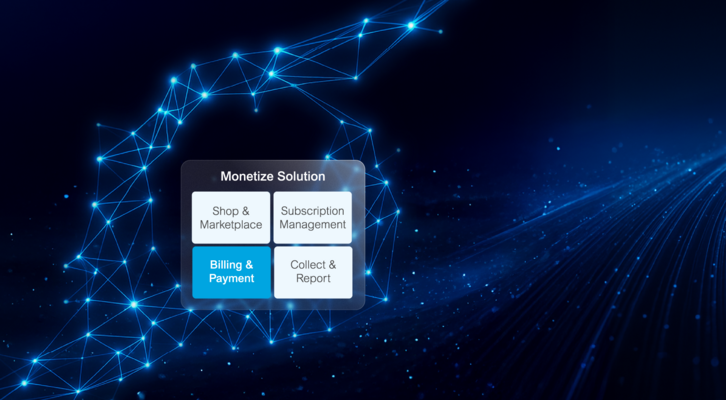
Automated Billing For Digital Business Models
Submit a requestBilling & Payment
In the context of digital services, traditional invoicing is changing fundamentally: instead of one-off PDF invoices, automated and scalable processes are now needed for recurring billing.
Modern billing systems consist of several stages: Usage data must be collected, evaluated and billed - including pricing logic, discounts and tax requirements. The integration of different payment providers and methods is also essential for a smooth payment flow.
The aim is an end-to-end billing process that reacts flexibly to business models, regions and frequencies - in real time and audit-proof.
The Stages of Billing:
Mediation

The use of services generates a large number of granular events (e.g. loading processes, API accesses, machine hours) that need to be received, validated, enriched and standardized. This data forms the basis for subsequent billing.
Rating

The standardized usage data is converted into billable units - including price calculation, discount logic, scales or special conditions. The aim is to generate billable items.
Invoicing

A legally compliant, traceable invoice is created from the billable items - with all legal requirements (e.g. VAT, national regulations) as well as detailed individual items (e.g. proof of use, discount overviews).
Payment

The invoice automatically triggers the connection to one or more payment service providers (PSPs). Different payment methods, billing cycles and country-specific requirements are taken into account.
Are You Concerned With These Current Issues?

Regulatory Diversity

Security & Compliance

Integration of Various Payment Methods

High Transaction Volumes

Transparency & Traceability

Rabatt- & Promotionsmanagement
From Transactional Business to Subscription Business


Read how a leading car manufacturer is redefining its subscription business: From strategic realignment to the introduction of a flexible billing system - the case study shows how digital services are now provided in over 2 million vehicles every year. Discover what hurdles were overcome, how efficiency and revenue increased and why subscription models are the future of the automotive sector.
Usage-Based Billing with Digital Twins
Read how innotec is transforming its business model with usage-based billing and digital twins: The case study shows how real usage data is automatically transferred into flexible billing models, transparency is created along the entire value chain and new revenue potential is sustainably tapped—and why data-based services are the key to the future.
Our Solution Approach
We rely on specialized billing architectures that are precisely tailored to complex, data-driven business models:
Scalable billing systems Our solutions map the subledger and general ledger separately - ideal for parallel billing flows and international client structures.
Standardized mediation We prepare usage data from any source in a standardized form - as a basis for automated rating and invoicing.
Automated tax processing The connection to tax providers ensures that legal requirements are applied correctly and according to location.
Secure payment integration Different payment service providers can be flexibly connected - taking into account international payment processes and compliance requirements.
The result: an end-to-end, automated billing process that reliably maps complex pricing logic, regulatory requirements and payment diversity - quickly, securely and scalably.
Discover Our Other Specialist Areas


We Ensure Your Billing of Digital Business Models!

 +49 7541 70078-781
FAQ on the Topic of Automated Billing For
Digital Business Models
What is billing & payment in digital business models?
How can a billing system be integrated into existing IT systems?
How do you deal with regulatory diversity in billing?
What needs to be considered when integrating payment service providers (PSPs)?
How does a billing system scale with growing business volumes?
What steps are part of a modern billing process?
What challenges arise when billing digital services?
How is the billing of usage-based services technically implemented?
How is security and compliance ensured in the billing process?
Why is an end-to-end billing process critical to the success of digital business models?

