
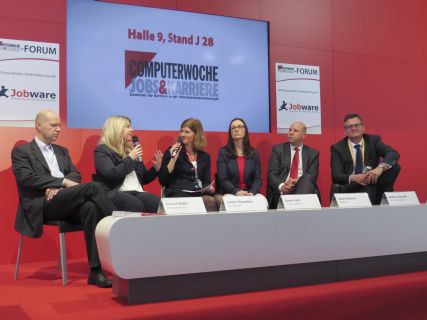
In order to avoid "the most common mistakes in job interviews", HR managers gathered at CeBIT in the Computerwoche career center to give listeners practical tips for their applications. Among them was personnel officer Leonie Hlawatsch from doubleSlash. In a packed room with many interested listeners, Karen Funk, editor for career topics at Computerwoche, wanted to hear anecdotes from the field and useful tips and tricks from recruiters.
Because when it comes to job applications, the odd mishap can happen. Dieter Schoon, Head of Human Resources at Intelligence, for example, has already had a case where an applicant sent a photo of a Neanderthal in their CV. Typical case: placeholder inserted and forgotten to remove. "We invited him anyway because we were interested in what he really looked like," says Schoon.
What sounds funny at first, however, can mean the end for an applicant in an emergency. To prevent this from happening, here is a summary of the most important dos and don'ts in job interviews from the experts at CeBIT:
Not too slick
A "slick CV" leaves recruiters with unanswered questions. After all, they want to know who the person behind the application is and whether or not they would be a good fit for the company. "The IT sector in particular is characterized by career changers. They have gained experience in other areas and I want to know that," says Nicole Mamier, Head of HR at Realtech. There can be many reasons why someone has studied longer or dropped out of university. The why is important here and ultimately comes across as more authentic than an "embellished" CV
The problem with duplications
Overlaps in the CV and the cover letter cannot be avoided. In the end, however, a comprehensive overall picture should emerge and there should not be two identical documents. Leonie Hlawatsch advises applicants to emphasize what interests them about the job in their cover letter. Why do I want to work in the company? What appeals to me about the job and where can I contribute my strengths?
Pick up the phone
The experts agree: If you are not sure whether you really fit the advertised job profile, it is best to clarify this in a personal interview on the phone. This establishes the first personal contact and breaks the ice. In case of doubt, you may also find that it doesn't fit. However, the advantage is that you know beforehand and don't have to put a lot of time and effort into the application for nothing.
The same also applies if a position is interesting but you can't meet the application deadline due to missing documents. "Then the company already knows that something is coming up and can prepare for it. And the personal contact has already been established," says Nicole Mamier.
What is the right format?
Online applications are now the standard. Mobile recruiting is becoming more popular and with it paperless applications. And that has several advantages: It saves money and the application can be easily forwarded within the company.
However, it is important that the scans are of good quality and combined in a PDF document - in the correct order, of course. However, if you still prefer a classic format and use paper, you are not doing anything wrong - the content is important!
Social media is part of it
The days when recruiters scoured the social media profiles of their applicants are over. Almost everyone is now networked. It is more important to be open, well connected and confident with the channels.
However, a quick check on Google or Xing to see who you will be dealing with in the interview is standard and almost expected - this applies to both the company and the applicant.
At the end of the day, the decision for or against an applicant is also a gut decision. HR managers have to assess in a short space of time whether an applicant is a good fit for the company or not. However, if certain things are taken into account, the chances of being invited to a personal interview increase.
Do's in the job interview:
- Subject line that is quick to grasp
- Emphasize special features/tell your personal story
- Show personality
- Make new positions/promotions in a company visible so that further development becomes clear. It should also be recognizable if it is the same company, especially if the name has perhaps changed.
- The CV and cover letter must form a unit but should not be duplicated 1:1
- Biting through in the interview: You have to realize that the applicant really wants the job
Dont's in the job interview:
- Misspelling names/spelling mistakes in the application
- Lack of seriousness
- Applying everywhere without any real interest in the job, which affects the quality of the application
- Too much individual data and certificates (only enclose references and certificates from the last few years and offer to submit further documents on request)

 +49 7541 70078-708
