

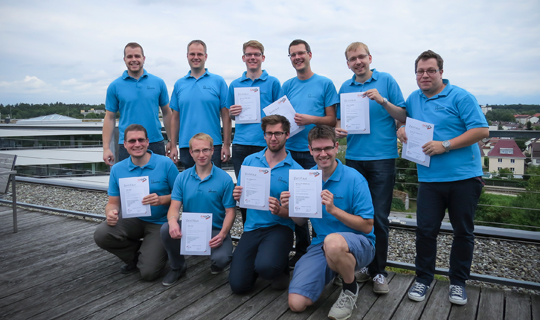
The International Software Architecture Qualification Board (iSAQB) is a registered association that creates and standardizes curricula, training courses and certification examinations for software architects. The CPSA (Certified Professional for Software Architecture) certification offered comprises three training levels: Foundation, Advanced and Expert Level. These were developed by experts from IT practice and academia.
Joint workshops and self-study lead to the goal
In order to achieve CPSA certification at Foundation level, a multiple-choice exam must be taken. Knowledge and skills from the field of software architects are tested. This ranges from basic terms and definitions to forms of documentation and design methods for software architectures. Completing the exam does not require any special training, but can also be done through self-study. At doubleSlash, a total of six workshops of two hours each were organized by two already certified colleagues in preparation for the certification. The candidates then studied the workshop content in greater depth using specialist literature.
Knowledge transfer creates the same understanding for good collaboration
"In this preparatory program, we covered theoretical and practical content and thus further deepened our common understanding of software architecture. This makes it easier for us to work together on software projects on a daily basis," say the two mentors Björn Voß and Klaus Moser.
Leonie Hlawatsch, Head of Human Resources at doubleSlash, is also delighted with her colleagues' certification: "Knowledge transfer is not just an empty phrase for us, it's a way of life. It is a great achievement that our colleagues have mastered the certification together via internal workshops. The certification is another nice confirmation of the successful project work that we do every day."
Congratulations once again to our colleagues.
 +49 7541 70078-708
