EWE Go: Modernizing the Offer-to-Cash Process
About the Customer
EWE Gois a wholly owned subsidiary of EWE AG that specializes in services related to electromobility. The company operates over 3,000 charging points in Germany and is one of the largest operators of public charging infrastructure, particularly in north-western Germany. EWE Go offers transparent and fair prices with no hidden costs or monthly basic fees. With the EWE Go app or the free charging card, customers have access to over 500,000 charging points across Europe.
The aim of the project was to fundamentally modernize EWE Go's existing offer-to-cash process. The processes—from offer preparation to billing—were to be made more efficient, transparent and future-proof.
The focus was on developing a solution that could keep pace with the dynamic growth in the eMobility sector as well as with increasing technical and regulatory requirements. A scalable and sustainable architecture enables EWE Go to implement new requirements and features such as new tariffs and to position itself as technologically independent in the long term.
Challenges
Growth and manual processes
Technical scalability & integrations
Compliance & end-to-end solution

Working with doubleSlash helped EWE Go to unite stakeholders and clearly structure our requirements. With their comprehensive expertise in the order-to-cash process, we were able to cover all relevant areas and make well-founded decisions—especially when it came to the question of which solutions should be developed internally and which should be purchased externally. We also benefited from their strong practical knowledge and good contacts. – Lukas Schneider, Teamlead digital Product Development, EWE Go

Right from the start, we formed a joint team with EWE Go—with experts from both sides. The collaboration was based on partnership and solution-oriented. The decisive factor was that we analyzed the complex requirements in the area of billing and pricing in a structured manner at an early stage and jointly transferred them into a scalable end-to-end solution. – Meike Vogt, Senior IT Consultant Monetize, doubleSlash
Measures to Achieve Targets
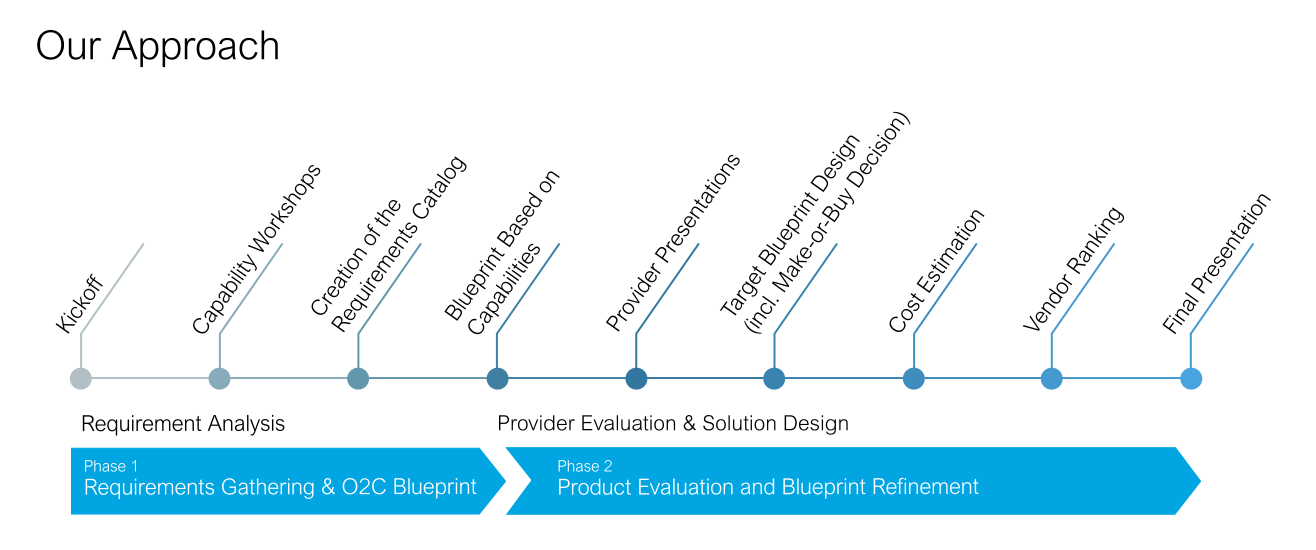
In the course of the project, all requirements were recorded in a structured manner with the relevant stakeholders, prioritized and aligned with the strategic direction of EWE Go.
The methodical foundation for this was the capability mapping—a structured procedure for analyzing and visualizing business capabilities and processes. This allowed technical requirements and business objectives to be linked and translated into a future-proof target architecture.
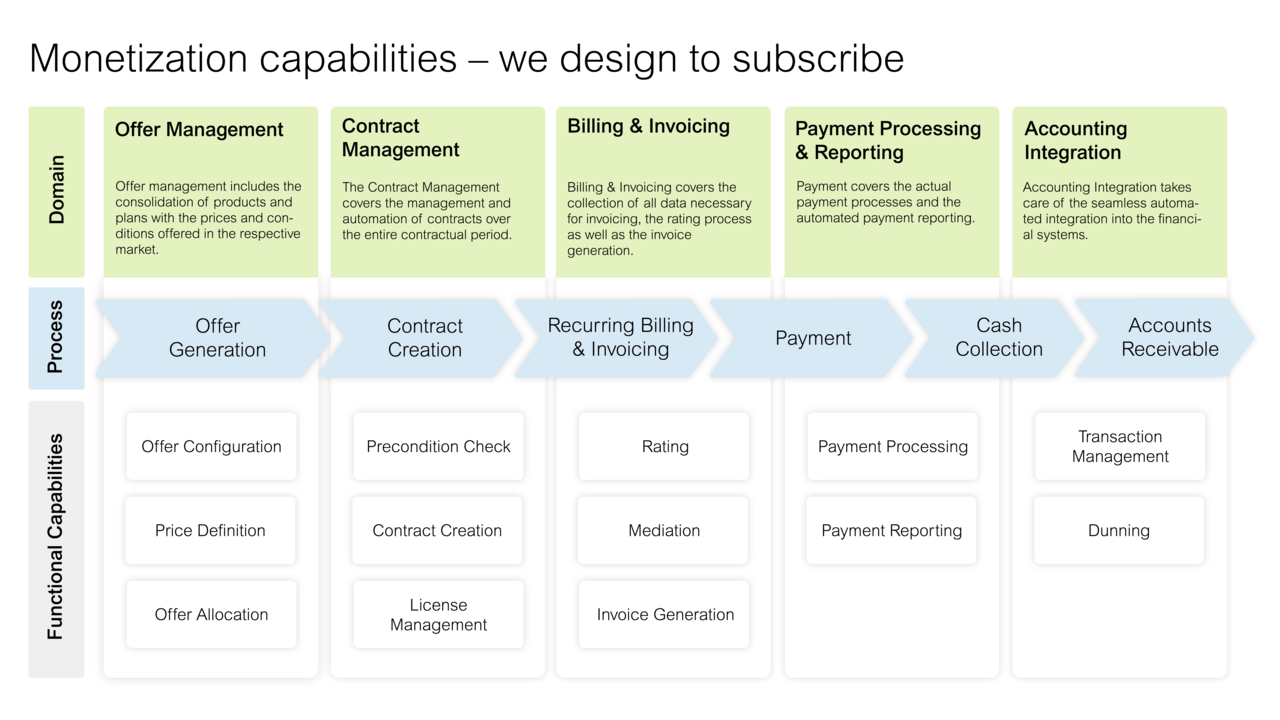
From Analysis Framework to Target Architecture
The Monetization BluePrint developed by doubleSlash was used for the implementation—a tried and tested architecture and process model for scalable billing processes that was specifically adapted to the requirements of EWE Go. In cooperation with the specialist departments, structured requirement lists and clear process and IT diagrams were created.
A key milestone was the decision as to which system components should be managed internally and which should be covered by external providers.
Based on this, providers were evaluated, target processes defined and a viable system architecture designed—as the basis for an expandable solution in the eMobility context.
Project Results
- Clear architecture scope & product recommendation
System architecture defined with strategic make-or-buy demarcation and sound product recommendation derived for the next implementation steps.
- Efficient decision-making processes
Structured requirements analysis and close collaboration led to a reliable basis for decision-making—including preparation of the proof of concept.
- Future-proof and scalable
The target architecture creates the basis for automated, scalable billing processes—and significantly reduces manual effort.

~ 100 technical requirements
collected, analyzed and prioritized

4 central billing
Capabilities restructured

5 product providers
evaluated
Flexibility and Scalability for Future Requirements
The solution developed was designed in such a way that EWE Go can operate flexibly and independently in the long term. Strategically important components were specifically anchored within the company so that there is no dependency on individual product partners.
When selecting the technologies, the focus was on a lean, modular architecture that can be seamlessly integrated into the existing system landscape. This enables EWE Go to react quickly and specifically to new market requirements—and to further develop the solution in line with demand.
What Can We Do for You?

 +49 7541 70078-781